About Dtangle
Dtangle is a Swiss deep-tech spin-off from CERN research, with a multidisciplinary team. We develop a visual analytics technology that allows users to map complex and interconnected data without coding. We allow users to navigate without boundaries or limits into their data in order to visualise trends, white spaces and additional insights that machines or humans alone could not understand.
The CORDIS SDG challenge is exactly this kind of problem: 23,451 projects, 17 goals, 169 targets, thousands of organisations and billions of euros, all connected to each other. This entry shows how Dtangle turns it into a transparent mapping, a working prototype and live graphs that anyone can explore.
Team entry. This notebook is submitted by Dtangle SA (Geneva, Switzerland) as a team: Marc Siegrist (team leader, submitting on behalf of the team), Jean-Marie Le Goff and Paul Bagourd. Should the entry rank among the top three, the certificate should be issued under the team name Dtangle.

Every Horizon Europe project, read for the SDGs
Dtangle read all 23,451 Horizon Europe projects in CORDIS and linked 17,437 of them (74 %) to the Sustainable Development Goals, at goal and at target level, using the EU Vocabularies SDG taxonomy. The result is 48,290 project-goal assignments, each with a confidence score, a confidence level and the sentence from the project that supports it.
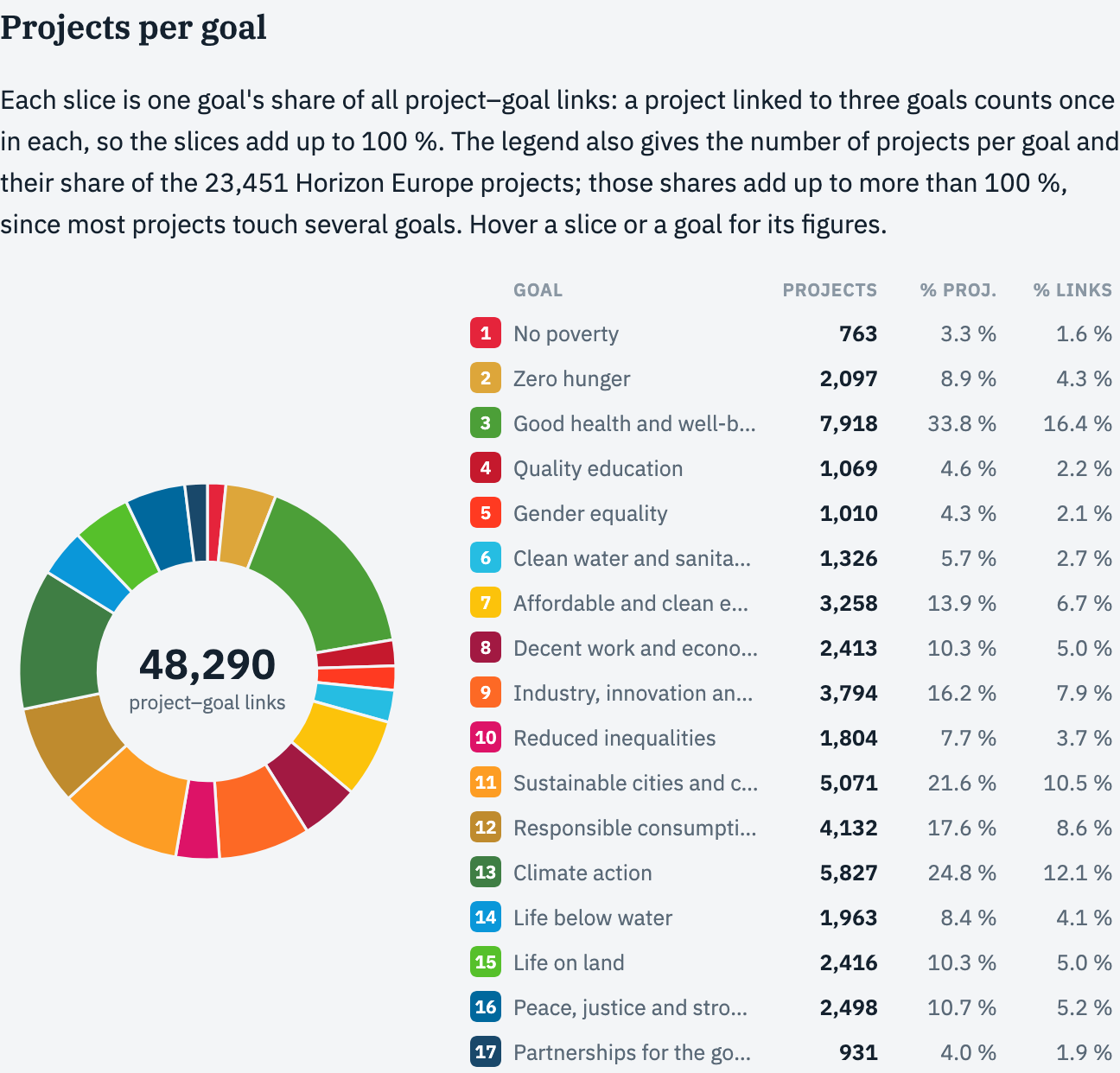
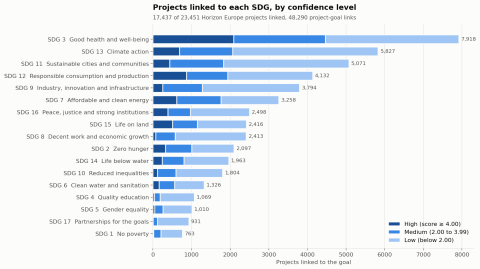
Health, climate and cities lead (SDG 3, 13 and 11). Poverty and partnerships (SDG 1 and 17) get the least attention. Two thirds of the linked projects serve several goals at once, and the way goals travel together is where connected-data analysis pays off.
Explainable by design, visual by nature
Each link points to the exact sentence of the project text that supports it, and all numbers can be recomputed from the delivered files. The method is deterministic: identical input yields identical output, and its accuracy was checked on an independently annotated set of projects.
In addition to the mapping, the entry maps where EU funding is directed, goal by goal and topic by topic, which goals and targets appear together, and where the portfolio leaves gaps in coverage.
Try it
Dtangle's prototype lets anyone explore the results, filter by goal, target, country or programme, trace each ranking back to its evidence and export ready-made tables that open as live graphs in the Dtangle platform: https://cordis.dtangle.ch. Its Data tab publishes the complete mapping table.
This page is the notebook of the entry: the Solution tab explains the data preparation, the mapping logic and the results. It comes with the complete project-to-SDG mapping table, the visualisations, a discussion of limitations and a description document.
Method, results, limitations and prototype
1. Why Dtangle's solution
Dtangle mapped the 23,451 Horizon Europe projects in CORDIS to the EU SDG taxonomy: 17,437 projects (74 %) are linked to at least one goal, through 48,290 project-goal assignments and 73,893 project-target assignments. Six choices set the solution apart.
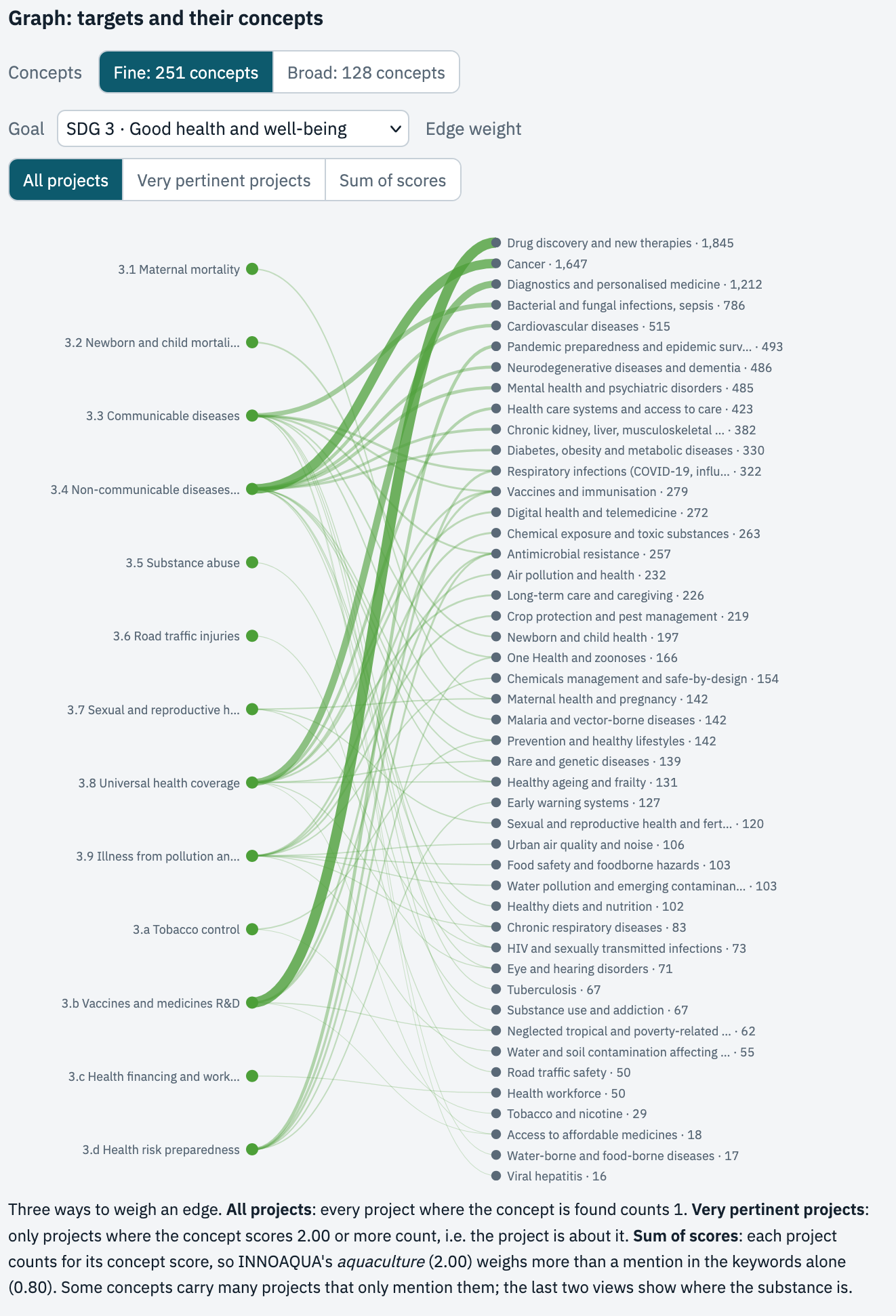
- Target-level precision through a concept layer. SDG targets are too abstract to search for. Dtangle broke the 166 in-scope targets into 251 concepts that research projects actually write about (target 7.2 becomes Solar energy, Wind energy, Bioenergy and biofuels...), each recognised by reviewed plain-language aliases (3,437 in total) with guards against false friends.
- A graded, explainable confidence score. Where a concept appears decides what it is worth: a title or an aim sentence weighs more than a background sentence. Each assignment carries its score, a High / Medium / Low level, a one-line explanation, the supporting sentence and the CORDIS fields used.
- Measured reliability. Against a reference reading of 60 hold-out projects, High links are confirmed 71 % of the time, Medium 45 % and Low 11 %, so every user can choose between recall and precision (block 7).
- Verifiable to the last digit. The matching is a deterministic program, with no model at run time. A separate script rebuilds every published score from the evidence tables with zero mismatch, and each assignment's evidence is stored losslessly in a single integer that the prototype decodes.
- Answers policy questions, not only labels. Funding is shared across goals in proportion to the scores (it adds up to each grant), co-occurrence of goals and targets is measured with and without concepts that serve two goals by construction, and a white-space index shows which concepts the portfolio leaves uncovered.
- Built for visual exploration. The results come as a working web prototype and as ready-made studies for the Dtangle visual analytics platform, where goals, targets, concepts and projects become live, navigable graphs. This is Dtangle's core capability: making complex, interconnected data readable without coding.
2. Data and preparation
- CORDIS Horizon Europe projects, from the European Data Portal dataset CORDIS – EU research projects under Horizon Europe (2021-2027): bulk extract of 2026-08-06, project, organisation, topics, legal basis and EuroSciVoc files, 23,451 projects. The text read for SDG evidence is the title, the keywords, the objective (public summary), the call topic title and the acronym.
- SDG taxonomy from EU Vocabularies (SKOS, http://data.europa.eu/sdg, v1.0): 17 goals, 169 targets, 232 indicators. Target, indicator and indicator-series labels were used to build the concepts. Every assignment in the mapping table carries the goal and target URIs.
- Organisations appear only as legal entities (name, country, type, role). No personal data is processed.
The portfolio. The largest funding schemes are MSCA postdoctoral fellowships (6,683 projects), ERC grants (5,020), research and innovation actions (2,830), coordination and support actions (1,681), ERC proof of concept (1,248), innovation actions (1,241) and the EIC (748).
Preparation. Each text is split into tokens, and the objective into sentences. Each token is normalised (case, hyphen or space, UK or US variant, plural of the last token). Each objective sentence receives a role from its phrasing: aim ("this project aims to", "we will"), impact ("will enable", "contribute to"), speculative ("could", "in the long term"), context (opening sentence, "currently", "however"), otherwise method. Negated mentions ("not", "without", "rather than" just before) are ignored.
Excluded targets. 9.5 (enhance scientific research), 17.6 (science and technology cooperation) and 17.16 (global partnership) are excluded: every Horizon Europe project would qualify. The 166 other targets are all covered.
Use of AI. The concept list and first drafts of the aliases were written with the help of a large language model (Claude, by Anthropic), then reviewed and corrected against samples of CORDIS projects. No model is used when projects are matched.
3. Mapping logic
3.1 From targets to concepts. A target such as 7.2 ("increase substantially the share of renewable energy") is too abstract to search for directly, so it is broken down into concepts a research project would write about. There are 251 fine concepts, grouped into 128 broad ones. Each records the targets it serves (possibly several, in several goals), a written rationale and a role: an outcome the target wants (123 concepts), a means such as a technology (91) or a domain of study (37). 66 targets rest on a single concept.
3.2 Aliases and guards. Each concept is recognised through plain-language aliases, 3,437 in total (median 12 per concept). For Poverty and multidimensional deprivation: "poverty", "deprivation", "low-income households", "poor communities", "at risk of poverty"... Exclusions stop a term where it means something else ("energy poverty", "fuel poverty", "sleep deprivation" are not poverty; "solar wind" is not solar energy; "cell migration" is not human migration). Required context binds some concepts to an application ("broadband" counts only with connectivity). The aliases were learnt once from how CORDIS projects actually write: first search patterns were run over the corpus, each term they caught was counted, forms seen only once and false friends were dropped (metasta* catches metastasis 282 times but also metastable, a physics term, 49 times). The lists are now fixed and editable; the projects teach how a concept is written, never which concepts exist.
3.3 Where a concept appears decides what it is worth.
| Where the concept is found | Who wrote it | Points |
|---|---|---|
| Project title | the applicant, deliberately | 1.00 |
| Objective, aim sentence | what the project will do | 1.00 |
| Objective, expected-impact sentence | what it should change | 0.90 |
| Objective, method sentence | how | 0.80 |
| Author keywords | the applicant, without context | 0.80 |
| Objective, context sentence | background, not commitment | 0.70 |
| Call topic title | the Commission: describes the call, not the project | 0.70 |
| Objective, speculative sentence | "could", "in the long term" | 0.60 |
| Acronym | only when the acronym is the concept | 0.60 |
| Repetition in 2 to 3 / 4 or more distinct objective sentences | +0.25 / +0.50 |
A concept counts as found when its best occurrence is worth 0.80 or more, or when it appears in two places worth 0.70. Its score is the sum of its best occurrence in each field: title + aim sentence + keywords = 1.00 + 1.00 + 0.80 = 2.80; a single method sentence gives 0.80. Two thirds of the links rest on a single field.
3.4 Structural signals add at most 1.20, from what the Commission itself records about the project. Only the strongest rule of each family counts.
| Family | CORDIS field | Rules | Weight |
|---|---|---|---|
| EU spending tracker (climate, biodiversity, clean air) | policy_*_pct | 3 | 0.50 at 100 %, 0.20 at 40 % |
| Programme part or EU Mission | legalBasis, topics | 36 | 0.40 direct, 0.20 partial |
| EuroSciVoc science category | euroSciVoc | 160 | 0.30 direct, 0.15 partial |
A structural signal alone creates a link only at full strength (3,880 links, marked "structural signals only"); otherwise it corroborates a link the text already made. Organisations, countries, dates and budget are never evidence.
3.5 Score and confidence. The score of a project for a goal is the sum of the scores of its distinct concepts serving that goal, plus the structural part; the same rule applies per target. Projects are ranked on a pertinence key that sorts by score, then by the counts that explain it.
| Confidence level | Score | Reading | Links |
|---|---|---|---|
| High | 4.00 or more | the project is clearly about the goal | 6,869 |
| Medium | 2.00 to 3.99 | the goal is a real subject of the project | 12,885 |
| Low | below 2.00 | the goal is mentioned | 28,536 |
3.6 One assignment, end to end: ProACCT ("Proteomic Analysis of Cell communication in Tumors"), SDG 3.
| Concept | Target | Found in | Score |
|---|---|---|---|
| Cancer | 3.4 | title 1.00 + aim sentence 1.00 + 9 distinct sentences 0.50 + keywords 0.80 | 3.30 |
| Diagnostics and personalised medicine | 3.8 | impact sentence ("...will provide the basis for advanced personalized treatment") | 0.90 |
| Drug discovery and new therapies | 3.b | method sentence ("...development of novel therapeutic approaches") | 0.80 |
| EuroSciVoc: clinical medicine / oncology | 3.4 | structural signal, direct | 0.30 |
SDG 3 score: 5.00 of text + 0.30 structural = 5.30, High, rank 1,101 of 7,918. The example also shows a limit: the project is mostly fundamental proteomics, and a human reader would call its link to health real but indirect.
3.7 Traceability. Every occurrence is stored as seven integers (concept, field, sentence, character offset, length, alias, sentence role), and the occurrences behind an assignment are packed into a single lossless integer, the evidence index (hyper-pyramid indexing of the SGDL group, patent US 9,900,024 B2). It identifies evidence and is never used to rank. A verification script rebuilds every published figure from the evidence tables alone: 46,315 concept scores, 48,290 SDG rows and 73,893 target rows with zero mismatch, 132,369 text positions checked, 168,498 evidence indexes re-encoded. The prototype recomputes the same figures in the browser and matches the published tables exactly.
4. Funding and white space
4.1 Funding: gross and allocated. A grant never raises pertinence: a EUR 20 m project is not more pertinent than a EUR 2 m one. The EU contribution is reported beside the score in two forms. Gross funding counts the whole grant for every goal the project touches ("how much funded activity touches this goal?"); it is not additive. Allocated funding shares the grant across the project's goals in proportion to their scores ("how much funding can be attributed to this goal?"); the shares add up to the grant, so they can be summed.
Example: ENDURE receives EUR 2,496,306 and is linked to SDG 11 (score 4.35), SDG 14 (1.60) and SDG 15 (1.65). Allocated: EUR 1,428,806.72 (57.2 %), EUR 525,538.11 (21.1 %) and EUR 541,961.17 (21.7 %), exactly the grant; gross would count it three times.
Over the 17 goals the linked projects receive EUR 50.7 bn; counted gross they would appear as EUR 164.9 bn. Health projects rarely serve another goal, so SDG 3 keeps 61 % of its gross amount (EUR 12.25 bn of 20.04 bn); SDG 1 keeps 14 % and SDG 17 17 %: poverty and partnerships are mostly touched by projects whose main subject lies elsewhere. Shares are computed in integer cents, identically in the pipeline and in the prototype.
4.2 White space. The same project-concept graph read the other way round: which concepts the projects leave uncovered. Six measures per concept (presence, intensity, depth = projects scoring 2.00 or more, allocated funding, robustness = effective number of projects carrying the funding, future = projects still running on 1 January 2028) are turned into percentiles; the white-space index is 100 x (1 - their mean), 100 being the least covered concept.
| Gap type | Rule | Concepts |
|---|---|---|
| Empty | 2 projects or fewer | 6 |
| Shallow | 10 or more projects, fewer than 5 % of them about the concept | 16 |
| Concentrated | 5 or more projects, funding carried by fewer than 3 effective projects | 4 |
| Fading | 5 or more projects, fewer than 30 % still running in 2028 | 5 |
| Thin | white-space index of 75 or more | 38 |
| Covered | none of the above | 182 |
Examples: Ocean acidification appears in 12 projects and is the subject of none (shallow); Deep sea and seabed ecosystems has 94 projects but its funding rests on the equivalent of 2.7 of them (concentrated); of the 50 projects on Road traffic safety, 11 will still run in 2028 (fading). Little coverage does not always mean a research need: the top of the ranking is dominated by development finance, served by other EU instruments, and a concept may be studied in terms its aliases miss. A high index is a reason to look, not a verdict.
5. The project-to-SDG mapping table
One row per project-goal assignment: 48,290 rows, 17,437 projects. The complete table is published as one CSV file (UTF-8, 38 MB): https://cordis.dtangle.ch/downloads/CORDIS_SDG_Mapping_Table_260924.csv (also listed, with a compressed copy and the column reference, in the Data tab of the prototype).
A sample with the same columns (the 100 top-ranked projects of each goal, 1,710 rows) is attached to this notebook as CORDIS_SDG_Mapping_Table_sample_top100_per_SDG_260924.csv, so that the table can be inspected without leaving the platform.
| Column | Content |
|---|---|
| project_id, acronym, project_title, cordis_url | CORDIS identifier, acronym, title, link |
| sdg, sdg_label, sdg_uri | assigned SDG concept and its EU Vocabularies URI |
| sdg_targets, sdg_target_uris | narrower SDG concepts (targets) and their URIs |
| thematic_concepts | the concepts found, which connect the project to those targets |
| confidence_score, confidence_level | score, and High (4.00 or more) / Medium (2.00 or more) / Low |
| rank_in_sdg | rank of the project among those linked to the goal |
| explanation | how the score is made: each concept with its matched terms and fields, each structural signal |
| evidence_excerpt | the best sentence (or the title) supporting the assignment |
| source_fields | CORDIS fields used: title, acronym, objective, keywords, topics, legalBasis, euroSciVoc, policy trackers |
| evidence_basis | concepts only / concepts and structural signals / structural signals only |
Example. SMOOTHER, SDG 7, High, score 11.70 = concepts 11.40 + structural 0.30. Explanation: Electric mobility and charging infrastructure [3.05]: 'charging stations', 'electric vehicle' in title, objective (aim), objective (repeated), keywords; Energy storage and batteries [2.80]: ...; EuroSciVoc renewable energy (+0.30). Targets 7.1, 7.2, 7.3.
A separate target-level ranking gives 73,893 project-target assignments with the same columns.
6. Main findings
- Three in four projects work on at least one goal (17,437 of 23,451). The other 6,014 are mostly fundamental research: 82 % of them are ERC (2,492) or MSCA (2,495) grants. Applied projects are almost all linked: only 4 % of innovation actions and 9 % of research and innovation actions are not.
- Confidence. 6,869 assignments are High (14 %), 12,885 Medium, 28,536 Low (59 %, mostly single mentions). 41 % reach a score of 2.00.
- Health, climate and cities lead: SDG 3 (7,918 projects), SDG 13 (5,827), SDG 11 (5,071), SDG 12 (4,132), SDG 9 (3,794), SDG 7 (3,258). Poverty (SDG 1, 763) and partnerships (SDG 17, 931) get the least attention.
- Most projects serve several goals: 65 % of linked projects, 2.8 goals each on average; 44 % when only scores of 2.00 or more are kept, 20 % at 4.00.
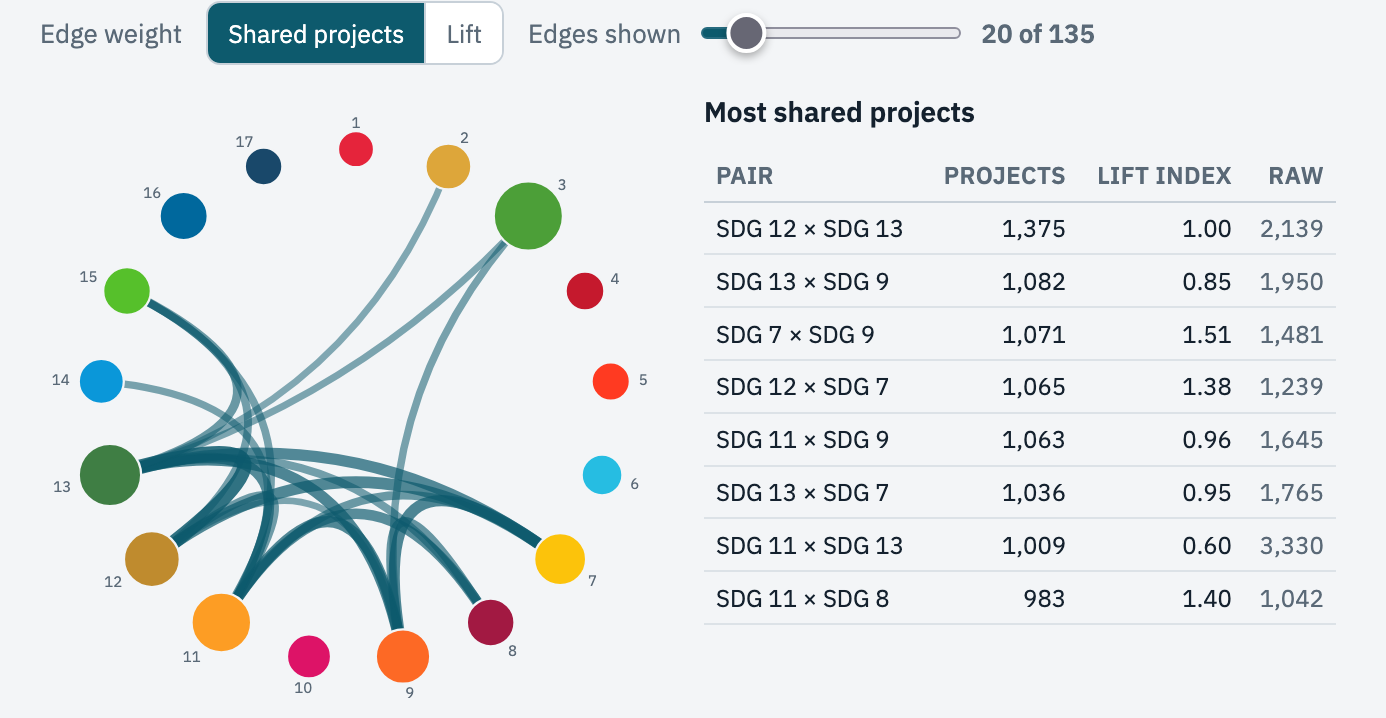
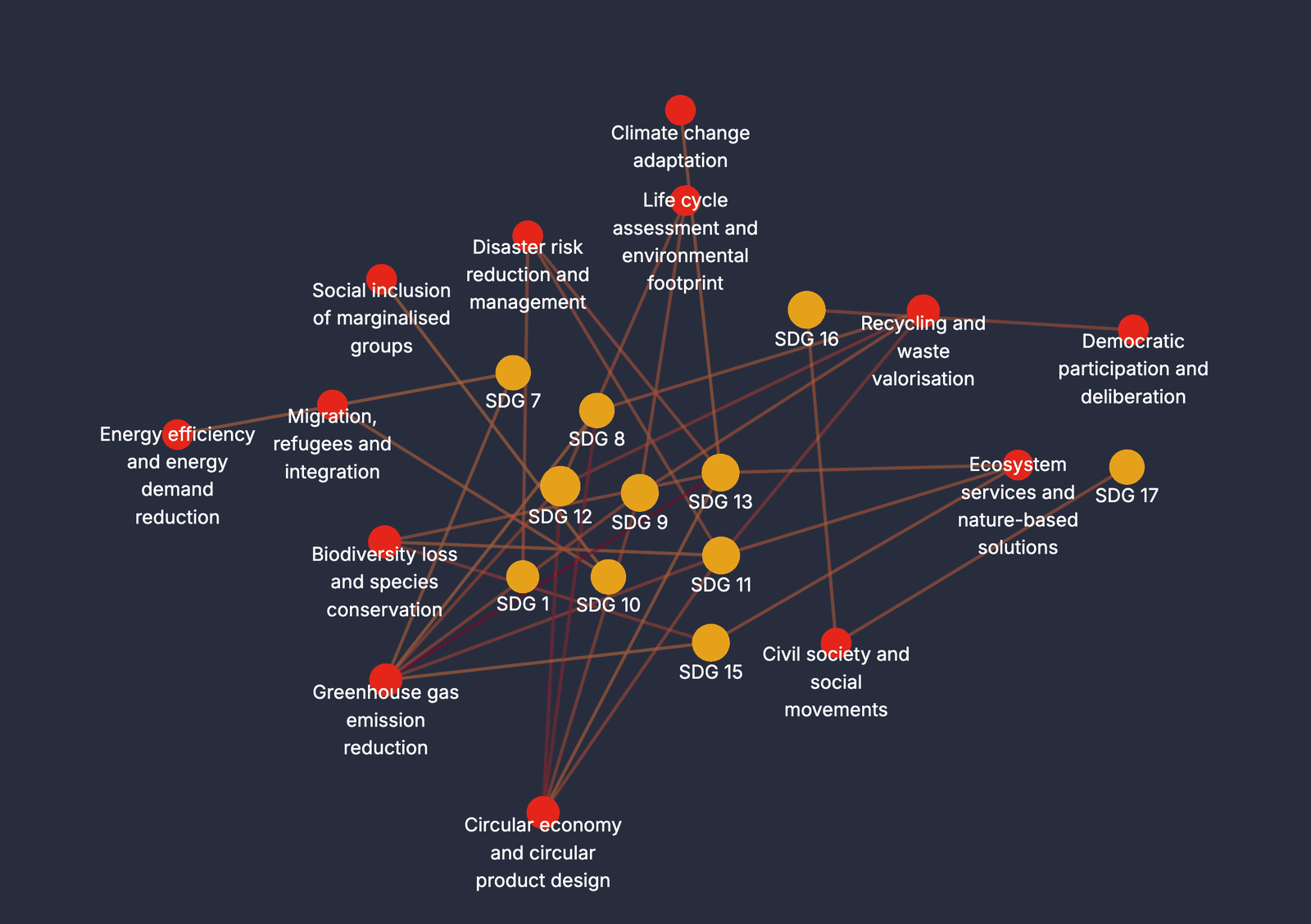
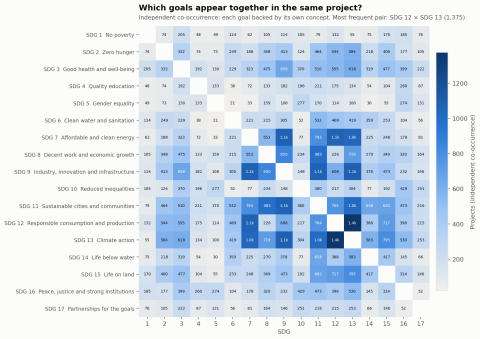
- Goals that travel together. 41 % of goal pairs come from a single concept serving two goals by construction (air pollution serves both health and cities), so pairs are counted on independent evidence, each goal backed by its own concept. Consumption and climate (SDG 12 x 13) meet most often, 1,375 projects (2,139 counting all); gender and inequalities (SDG 5 x 10) pull hardest, 2.65 times what chance would give. Among projects really about their goals (score 2.00 or more), climate and life on land (SDG 13 x 15) lead with 333 projects.
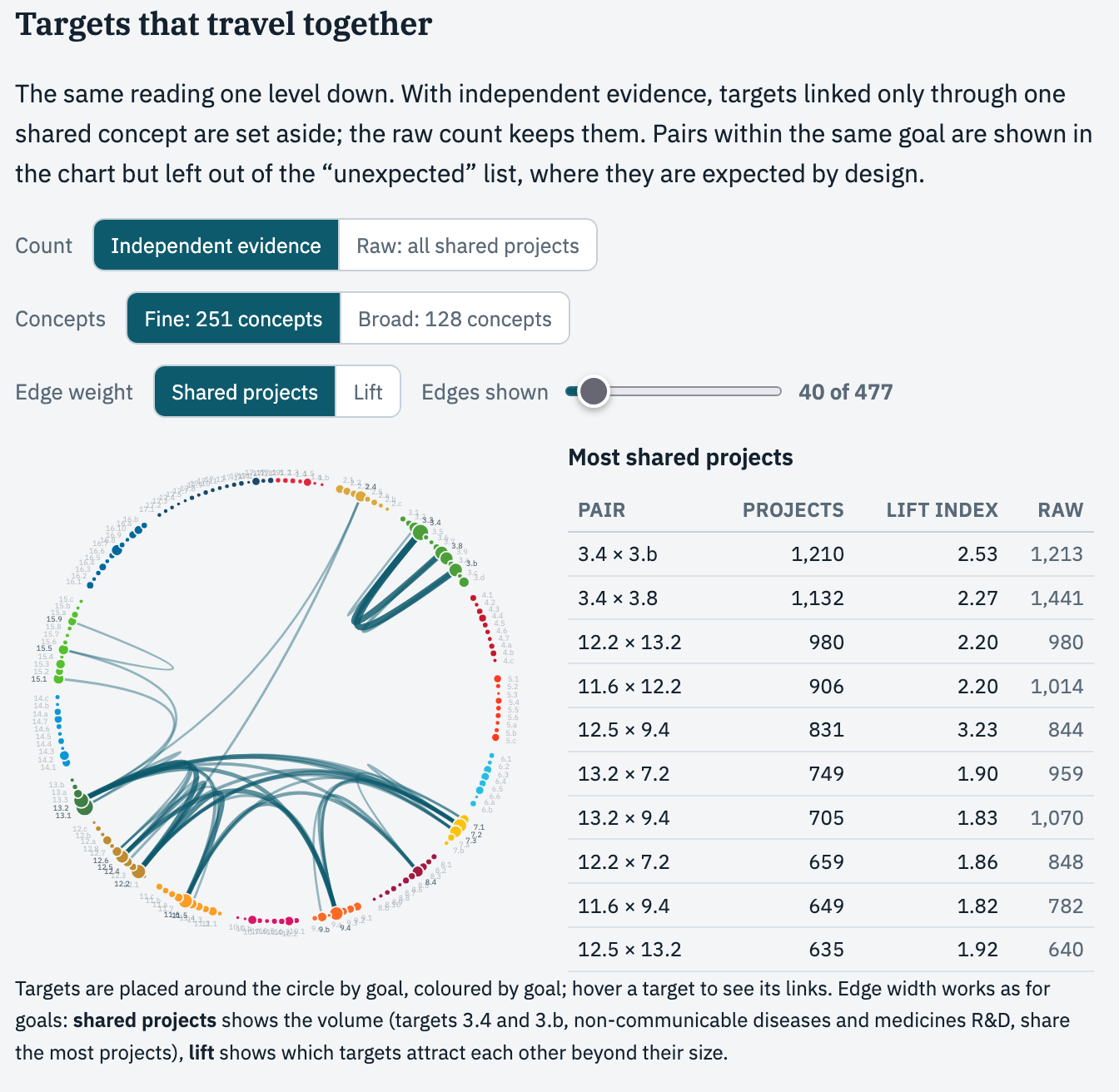
- Targets that travel together. Non-communicable diseases and vaccines and medicines R&D (targets 3.4 x 3.b) share 1,210 projects on independent evidence; sustainable use of natural resources and climate measures in policies (12.2 x 13.2) 980.
- Where the evidence comes from. The best evidence of a link sits in an aim sentence for 35 % of links, a method sentence 23 %, the title 22 %, the keywords 12 %, an impact sentence 8 %.
- Funding. The 20 best-funded concepts, led by greenhouse gas emission reduction (EUR 2.3 bn) and cancer (EUR 2.0 bn), take 42 % of the EUR 49.9 bn that can be attributed to concepts. Projects and money do not rank the same way: aviation and maritime decarbonisation has 91 projects but EUR 740 m, about EUR 8 m per project.
- White space. Of 251 concepts, 6 are empty, 16 shallow, 4 concentrated, 5 fading and 38 thin.
Figures fig1 to fig5 and six Dtangle graph views are attached. Interactive versions, with three series (all links, score 2.00 or more, 4.00 or more) and a fine / broad concept switch, are in the Results tab of the prototype, and the underlying studies open as live graphs in the Dtangle platform.
7. Limitations, uncertain cases and possible improvements
7.1 How reliable are the links? Measured against a reference reading
60 projects drawn at random across all parts of the programme (8 ERC, 8 MSCA, 7 climate-energy-mobility, 6 food and environment, 6 digital and industry, 6 health, 5 EIC, 4 missions, 4 culture and society, 3 security, 3 other) were read in full and annotated with their goals and targets, blind to the method's output. They were never used to build or tune the method (hold-out set). A second set of 150 projects (pilot) gives the same picture. Goal level:
| Links kept | Share confirmed by the reader (precision) | Share of the reader's goals found (recall) |
|---|---|---|
| High only (score 4.00 or more) | 0.71 (pilot 0.81) | 0.43 (pilot 0.40) |
| Medium only (2.00 to 3.99) | 0.45 (pilot 0.43) | |
| Low only (below 2.00) | 0.11 (pilot 0.12) | |
| Medium + High (score 2.00 or more) | 0.56 (pilot 0.60) | 0.76 (pilot 0.68), F1 0.65 |
| All links | 0.33 (pilot 0.34) | 0.92 (pilot 0.84) |
What this means. The confidence level does its job: the higher the level, the more often a careful reader agrees. High links are right about three times in four. Low links almost never match the reader: they record that a goal is mentioned, not that the project is about it. Dtangle therefore recommends the Medium + High view (score 2.00 or more) for most uses: it finds three quarters of the goals a reader assigns, and in the hold-out none of the 17 projects the reader judged goal-free receives a Medium or High link. Low links are kept, clearly marked, for recall: with them the method finds 92 % of the reader's goals. The exact target is harder than the goal (target-level F1 0.51 at score 2.00 or more).
Caveats. The reference reading was made by one annotator, an AI model (Claude) working blind to the method's output; it has not yet been checked by a human second reader. An earlier rule-based version of the method reached F1 0.72 on the same 60 projects, but linked 14,724 projects instead of 17,437 and gave no concept-level evidence. All figures are in Validation_reference_reading_260924.csv.
7.2 What the method cannot see
- Some targets are not research topics. Targets about finance, trade and aid to developing countries are served by EU development and trade instruments, not by Horizon Europe research grants. Few projects write about them: 8.a (Aid for Trade) matches no project, 10.b (development assistance) one, 10.c (remittance costs) three, 17.4 (debt sustainability) and 17.5 (investment promotion) six each. This is why SDG 1 (763 projects) and SDG 17 (931) are the smallest goals: the low counts describe the portfolio, not a failure of the method.
- Only what the project wrote at the start is read. For each project the method reads the title, keywords, call topic, acronym and objective (the public summary written when the grant was signed), in English. Deliverables, periodic report summaries and publications exist in other CORDIS datasets but were not in the extract used, so a goal that appears only in a project's results is missed.
- Projects with no link. 6,014 projects get no link; 4,987 of them are ERC (2,492) or MSCA (2,495) fundamental-research grants whose summaries mention no societal goal.
- Terms, not meaning. A term used in another sense can create a link: "deprivation" in androgen deprivation therapy (a cancer treatment) linked DE-ESCALATE to poverty (SDG 1, score 2.00); "urban air" in Urban Air Mobility (drones, air taxis) linked OPENSRUM to air quality (SDG 3, score 2.00). Conversely an idea written in unforeseen terms is missed.
- Writing, not impact. A high score means a project writes about a goal, not that it will deliver on it.
- Length. Scores are not normalised for text length; repetition is capped at +0.50, but longer summaries still have more chances to match.
- Weights are a judgement, fixed before the run, not fitted. They sit in one file and every figure can be recomputed with other values.
7.3 Uncertain cases
| Case | Links | Example |
|---|---|---|
| Low confidence (score below 2.00) | 28,536 (59 %) | precision 0.11 on the hold-out (see 7.1) |
| A single mention in a method sentence (score 0.80) | 4,733 | PFAS-ITOX (immunotoxicity of PFAS in children) linked to SDG 11 because "airport" appears once |
| Commission classification only, no text evidence | 3,880 | GAMES (mass extinctions in the Mesozoic) linked to SDG 11 because its budget counts 100 % towards the EU clean-air tracker |
| Near the Medium threshold (score 1.80 to 2.20) | 4,929 | the level could flip with a small change of weights |
| Known false positives | 2 | DE-ESCALATE and OPENSRUM (above) |
A sample of 77 of these cases (the 2 false positives and 25 of each other kind, fixed random seed), with their explanation and evidence, is in Uncertain_cases_sample_260924.csv.
7.4 Possible improvements, most useful first
- Drop or down-weight the weakest Low links (single method sentence, structural signal only), the group with the lowest measured precision.
- A human second reading of the 210 annotated projects, then fit the field weights on it instead of setting them by judgement.
- Tighten the aliases behind the false positives and add guards learnt from that reading.
- Read more text: report summaries, deliverables and publications, and non-English summaries.
- A semantic path (embeddings) to catch unforeseen phrasing, keeping the lexical evidence as the explanation.
- A length-adjusted score beside the raw one.
8. Prototype, Dtangle platform and reproducibility
Prototype: https://cordis.dtangle.ch/, prepared by Dtangle (a single web page, no server code).
- About us: Dtangle, its platform and its team.
- Results: the findings, interactive, with network views of goals and targets that travel together, and an In Dtangle section with eight graph views from the Dtangle platform (a goal and its targets, a target and its concepts, cross-cutting concepts, the whole grid filtered by weight), each opening the study in Dtangle.
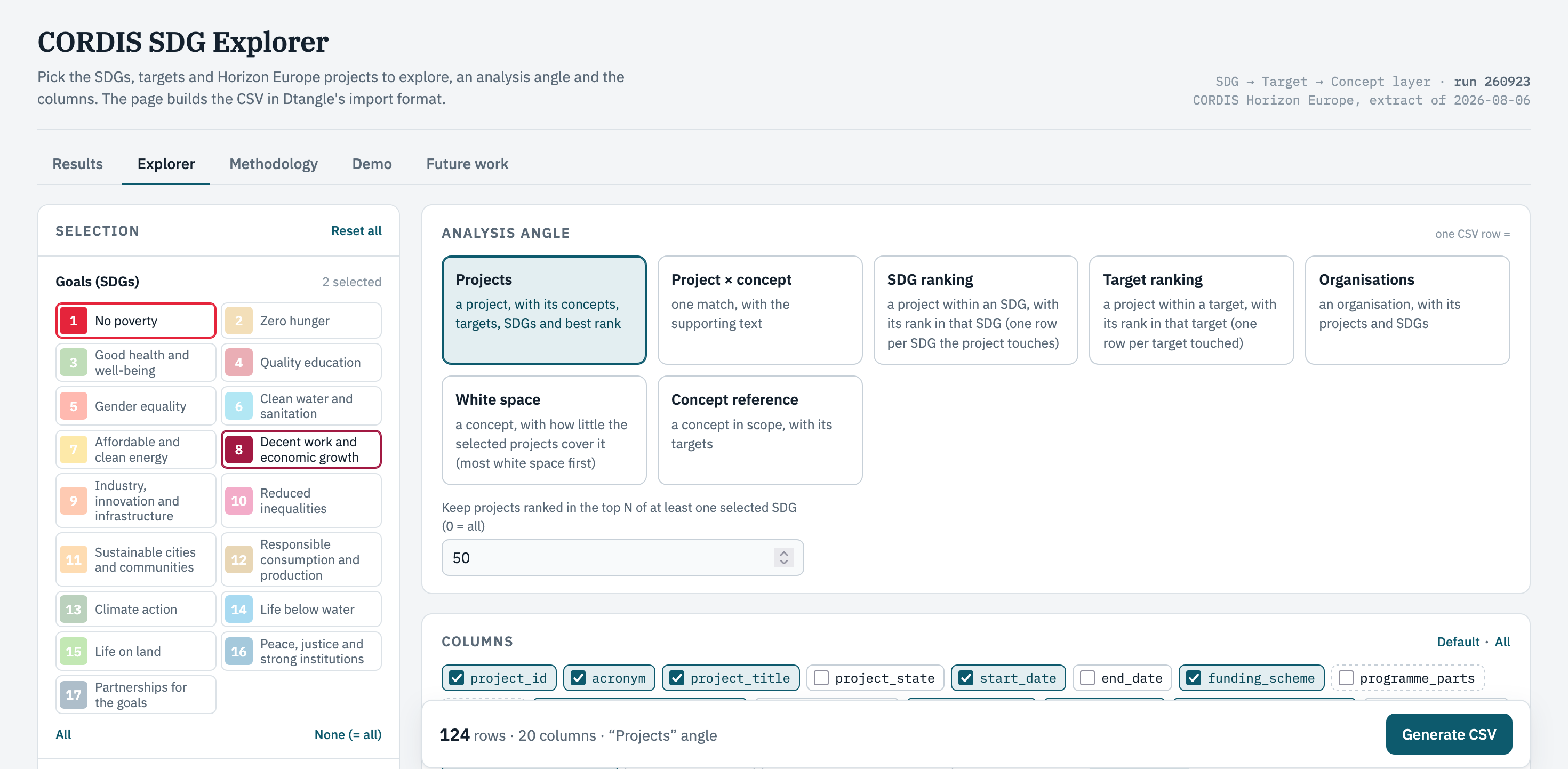
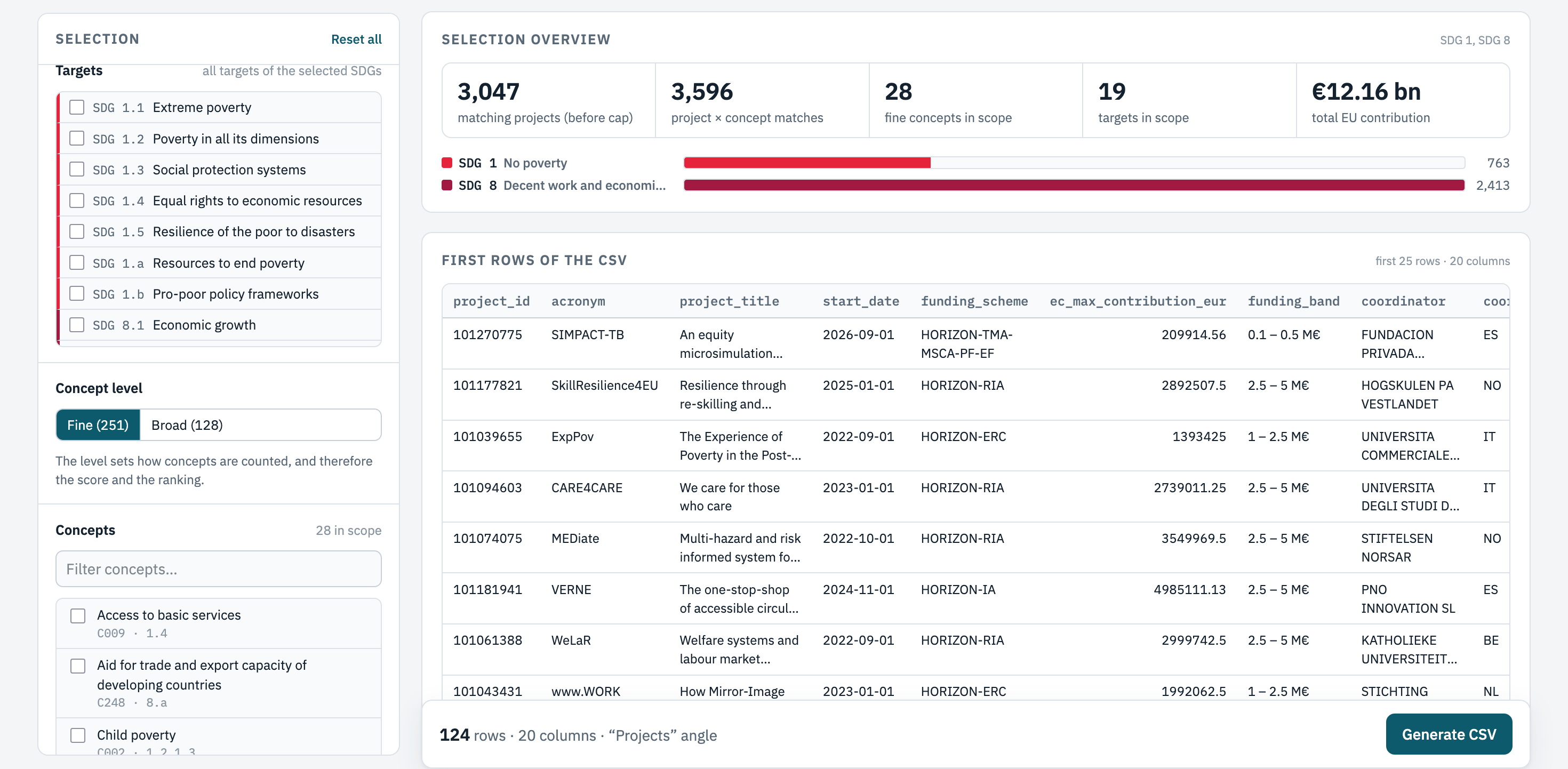
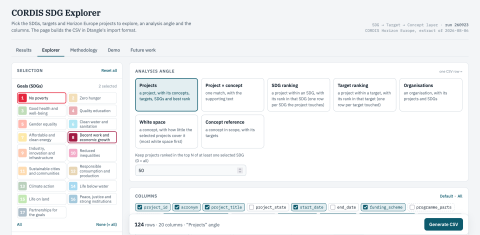
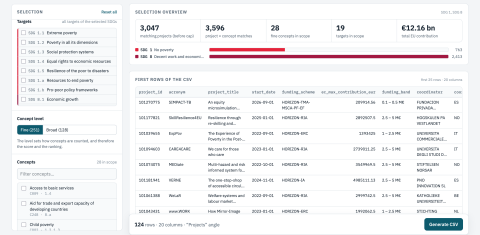
- Explorer: pick goals and targets, filter (countries, programmes, organisation types, minimum score, structural signals on or off), choose an analysis angle (projects, project x concept, SDG or target ranking, organisations, white space), pick columns, preview and export a CSV. Every ranking can be traced back to its evidence.
- Data: the complete mapping table (CSV 38 MB, zip, 1,710-row sample), the column reference, the source datasets, the JSON tables the page loads, and the licence.
- Methodology: the full method, with a decoder for the evidence codes.
- Future work: a third code to find projects with similar evidence profiles.
The page recomputes scores, ranks, coverage and allocated funding in the browser; a parity test confirms it reproduces all 48,290 SDG rows and 73,893 target rows of the published tables exactly.
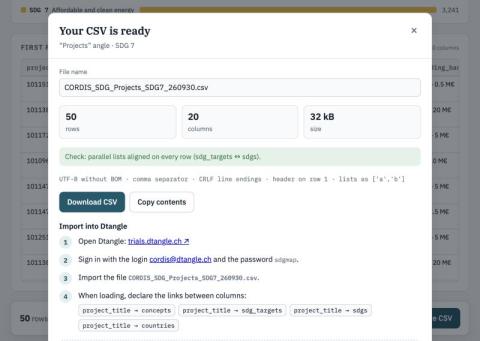
Dtangle platform. The exported studies (goals, targets and concepts, in three series) open in the Dtangle visual analytics platform, where they become live graphs: https://trials.dtangle.ch/ (login cordis@dtangle.ch, password sdgmap).
Reproducibility. Plain Python scripts; one command runs matching (8 parallel shards, about a minute), assembly, white space, independent verification, the results report and the prototype data. Full reruns are byte-identical.
Licence. The mapping tables, the validation and uncertain-cases files, the figures and the documents are released under Creative Commons Attribution 4.0 (CC BY 4.0): CORDIS and the European Data Portal may reuse them freely, with attribution to Dtangle SA. The prototype and the Python scripts remain © Dtangle SA 2026; CORDIS and the European Data Portal may reuse them for their own purposes, and the source is available to the evaluators on request. Third-party data (CORDIS, EU Vocabularies) keep their own licences.
Resources attached: the description document, the limitations document with the validation figures and a sample of uncertain cases, a 1,710-row sample of the mapping table, and the figures (PNG).